

Video: David Bayer, “Everything you want comes when you outsmart the game of reality.” Summary and commentary are mine.
Some of the most persistent beliefs I meet in my work sound like this: “If I rest, everything falls apart.” Most of us have a version of it. We rarely examine it.
I recently viewed David Bayer’s video on “outsmarting” the game of reality, and I found five ideas worth sharing. Some hold up well. Some are metaphor. All five connect to what I see in burnout, and to the book I am about to release. Below I paraphrase each idea briefly, then share my take.
Rule 1: Look past the surface
Bayer’s idea: What looks solid and fixed is only one way to describe the world. There is always more going on beneath what we see.
My take: I read this one as metaphor, not physics. The practical point is the one that matters to me: what we believe sets what we notice. Most of us run on beliefs we have never examined. In the Person-First Mission Method, examining them is where the work begins.
Rule 2: Your brain builds your experience
Bayer’s idea: We never see the world raw. The brain assembles a simplified picture shaped by memory and habit, and we treat that picture as the whole thing.
My take: Burnout often starts with a belief like “if I rest, everything falls apart.” That belief filters out rest, support and options. A person caught in it is not being dramatic. They are working from a narrowed picture. Name the belief and the picture widens.
Rule 3: You are not your thoughts
Bayer’s idea: Thoughts arrive on their own, including the anxious ones. You can observe them come and choose which ones to follow.
My take: Awareness loosens a pattern’s grip. In the Person-First Mission Method the pause comes first. I ask two questions: whose rule is this, and is it still true? Many of the rules we live by were set by a former boss, a family system or a version of ourselves that no longer exists.
Rule 4: Your state colors what you see
Bayer’s idea: Mood and expectation act like a lens. Change the lens and the same day looks different, and you act differently in it.
My take: A depleted person reads everything as a threat. In my book I call the skill that counters this response-agility: noticing your body’s activation, creating a sliver of space and choosing your next move. I picture it as a box of crayons. Pick the dark, moody colors, and your body follows with a tight jaw and narrowed vision. Pick the bright ones, and you move with more breath, more options and more connection. The box is always there. But burnout is not a mindset flaw. Workload and systems matter too, and I will not suggest that a better attitude fixes an unsustainable job. Restore the person first, then reassess.
Rule 5: “Decide, don’t hope”
Bayer’s idea: Hope waits for something to change. A clear decision closes off the alternatives and ends the inner conflict.
My take: Mixed signals drain energy. One clear decision, like a boundary tied to your mission, frees it up. Hope without a next step is just waiting. This is where I like to equip people to move from insight to action.
What to do with this
If one rule stood out, start there. Write down the belief that runs your week. Ask whose rule it is. Then make one clear decision this week and keep it.
My book, Burnout Isn’t What You Believe: The Person-First Mission Method, launches January 15, 2027. It walks through how beliefs, state and decisions shape burnout, and how to recover in partnership with your team. Look for launch news at momentumpeoplesolutions.com.
If you want to work with me directly, I offer two programs:
Download the one-pager
I turned these five rules and my commentary into a one-page summary you can keep or share with your team.
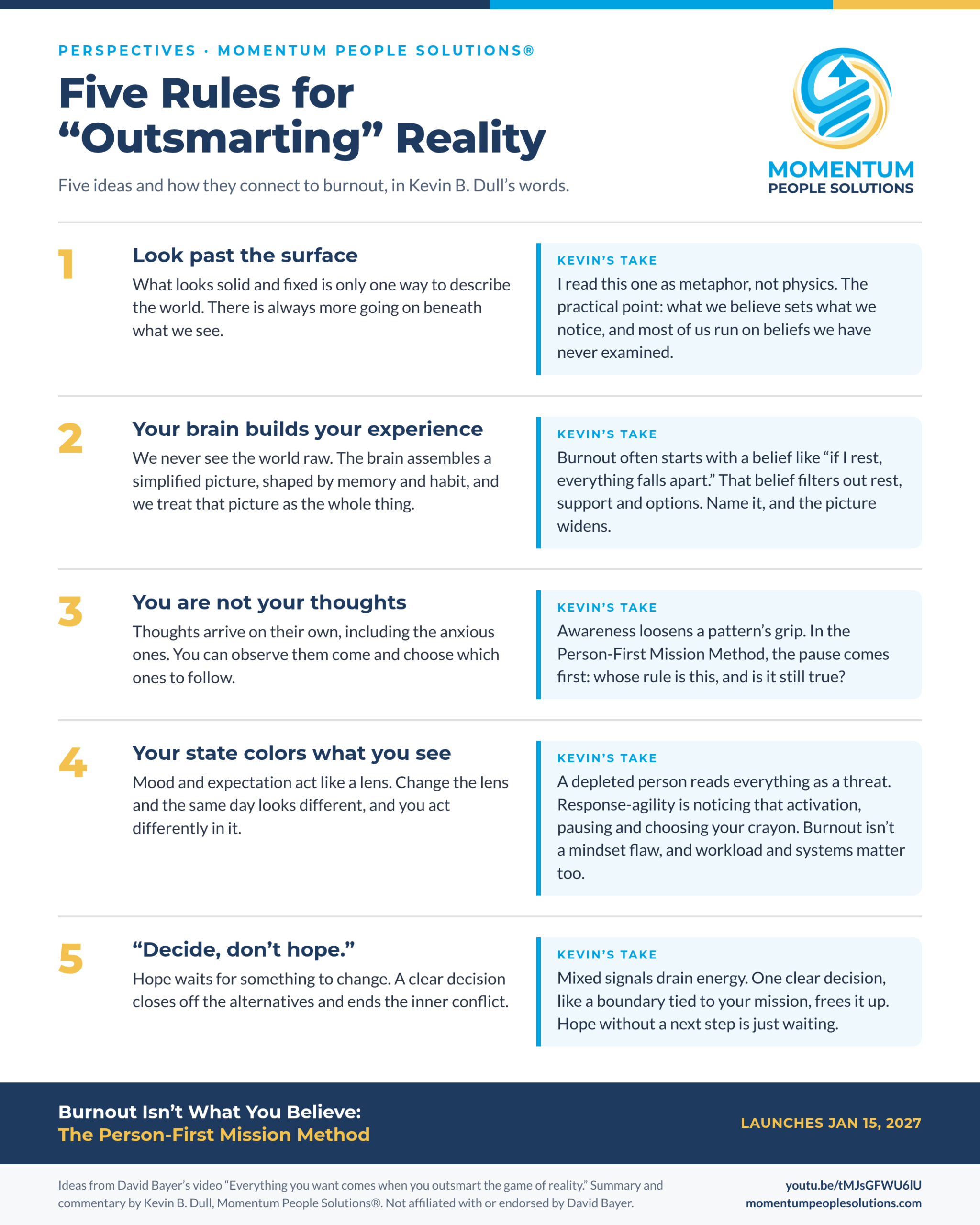
Download the One-Pager (PNG) Download the One-Pager (PDF)
Kevin B. Dull, JD, MBA, MS in Leadership, Founder of Momentum People Solutions®, brings nearly a decade as a healthcare CHRO and nine years in the public sector to the work of partnering with people on burnout and leadership.
Not affiliated with or endorsed by David Bayer.
