


What if the most exciting version of your life isn’t something you plan, but something you discover?
From our earliest days we’re taught to decide. What’s your plan? What degree are you pursuing? What job will you land after college? Where do you see yourself in five years? Those questions become performance goals, and performance goals become the yardstick we use to measure ourselves.
There’s nothing wrong with determination. But I’ve coached enough people to know that determination aimed at the wrong target can leave you exhausted, successful on paper and strangely empty inside.
Whose goal are you chasing?
Here’s what often happens. Our parents, colleagues, teachers and society share, openly and with love, what they believe we’re capable of. We pick up that path and run with it. Years later we wonder why the finish line doesn’t feel like ours.
Psychologists Julius Kuhl and Miguel Kazén have a name for this: self-infiltration. As Richard Ryan and Edward Deci describe it, “In self-infiltration, individuals adopt goals that someone else holds for them ‘as-if’ the goals were their own. It involves misidentifying someone else’s goals as their own goals.”
If that line made you pause, you’re not alone. And the good news is that you don’t have to choose between a rigid plan and simply wishing for something to show up. There’s a third way.
Sensing the future that wants to emerge
C. Otto Scharmer, author of Theory U, invites us to lead “from the future as it emerges.” Instead of forcing a predetermined outcome, we become receptive to a new reality that is already trying to take shape in us.
So here’s my question for you: How many windows can you open to your emerging future?
The key that opens those windows is a learning goal.
Why learning goals light us up
Carol Dweck’s research shows that people pursuing learning goals, aimed at growing their ability rather than proving it, keep reaching for challenges and stay resilient when things get hard, while people focused on proving themselves are more likely to back away when they stumble.
Ryan and Deci’s Self-Determination Theory tells a similar story. They describe intrinsic motivation as “a growth oriented source of energy that leads people to take on optimal challenges” and to master their world “by stretching their skills and knowledge.” External incentives, by contrast, tend to produce “a more focused and rigid pursuit of a goal extraneous to the learning itself.”
One study brings this to life. Students were given three hours to learn the same material. Half were told they’d be teaching it to other students. The other half were told they’d be tested on it. The students who learned in order to teach “evidenced significantly greater intrinsic motivation and demonstrated significantly better conceptual understanding than participants who learned in order to take an exam.”
Isn’t that beautiful? When our learning is in service of others, we don’t just perform better. We come alive.
You were built to grow
Ryan and Deci’s conclusion is one of the most hopeful ideas I know. People are not passive, waiting for a carrot or a stick. We are “active organisms,” with “an inherent growth tendency within individuals that needs to be supported.”
When that growth tendency is free to move, they write, “individuals move autonomously toward new challenges, wider frames of experience, and increased coherence in understanding. They enact behaviors that interest them, seek stimulation, test limits, and open assimilation of what is novel.”
That’s you at your best: curious, stretching, becoming.
Open your windows: a simple practice
- Remember your self-chosen learning. Write down moments when you learned something simply because you wanted to, not because someone expected it or rewarded it. What pulled you in?
- Name your learning goals. Start small and let them grow:
- Cooking
- Physical fitness
- Creative pursuits such as painting, music or woodworking
- Expertise in service of others: what could you teach someone else?
- Career: what are you naturally drawn to outside your current path?
- Notice what lights you up. Pay attention to the goals that give you energy instead of draining it. That energy is a signal from your emerging future.
Each learning goal is a window. Open one, and you may be surprised by the view.
You are the hero of your own journey, and the next chapter doesn’t have to be written by someone else. If you’d like a guide as you explore it, I’d love to walk alongside you through You Are a Hero on a Journey Career Coaching.
Download the one-page infographic
Keep these ideas close. Download the free one-page infographic and share it with someone who’s ready to open a window of their own.
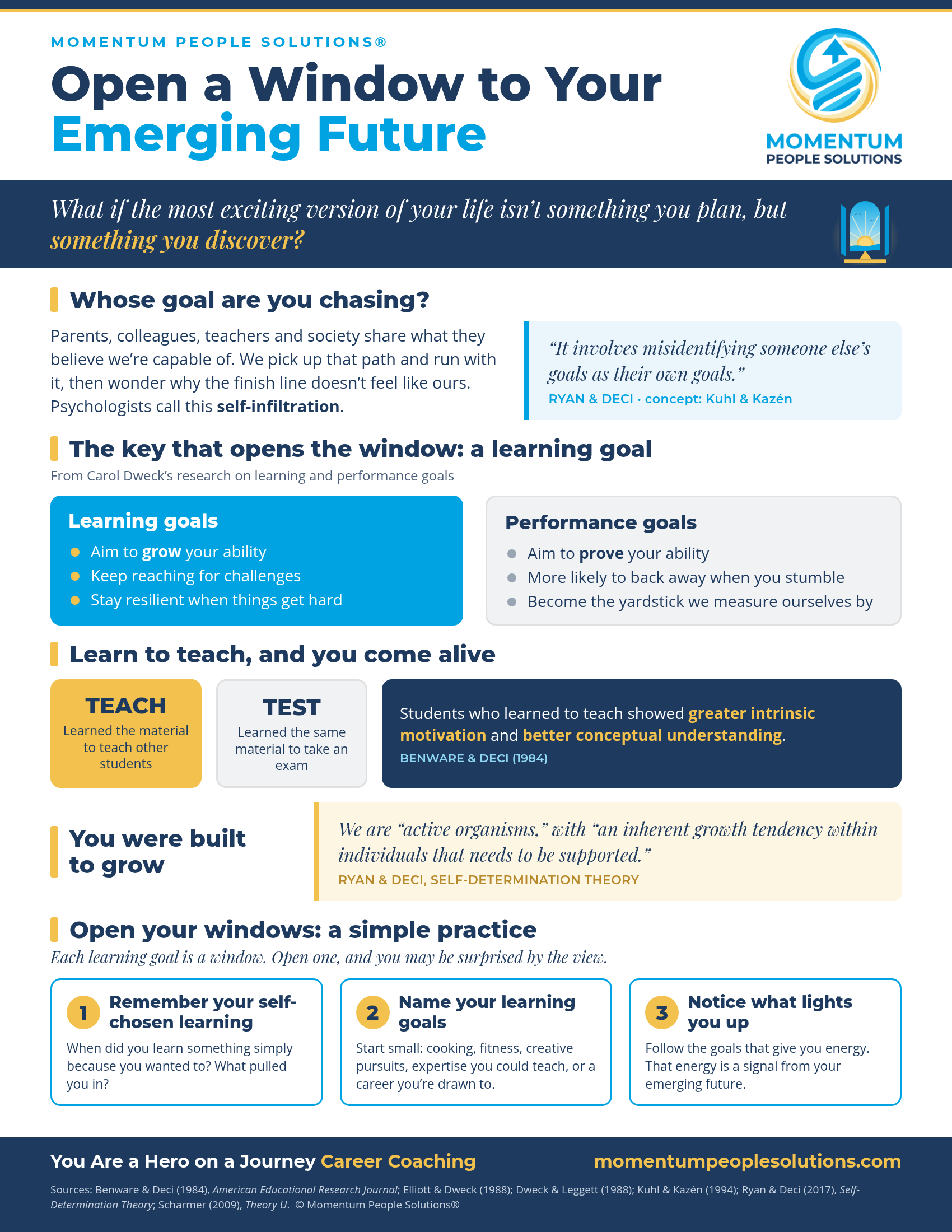
Download the Infographic (PDF)
Sources
- Benware, C. A., & Deci, E. L. (1984). Quality of learning with an active versus passive motivational set. American Educational Research Journal, 21(4), 755–765.
- Elliott, E. S., & Dweck, C. S. (1988). Goals: An approach to motivation and achievement. Journal of Personality and Social Psychology, 54(1), 5–12.
- Dweck, C. S., & Leggett, E. L. (1988). A social-cognitive approach to motivation and personality. Psychological Review, 95(2), 256–273.
- Kuhl, J., & Kazén, M. (1994). Self-discrimination and memory: State orientation and false self-ascription of assigned activities. Journal of Personality and Social Psychology, 66(6), 1103–1115.
- Ryan, R. M., & Deci, E. L. (2017). Self-Determination Theory: Basic Psychological Needs in Motivation, Development, and Wellness. Guilford Press, pp. 174–179.
- Scharmer, C. O. (2009). Theory U: Leading from the Future as It Emerges. Berrett-Koehler.
