Are you an acolyte for living in the now?
Ekhardt Tolle’s guidance: psychological time is living in past and future stories—regret, rumination, brooding, identity, worry, fantasizing about the future – leading to mind-made suffering. Use clock time only to act plan, then return to now. Only this moment is real; inhabit it.
I found myself violating his guidance.
I told myself that I was simply reflecting on the past. But was I really “ruminating and brooding?”
This led me to investigating whether I was telling myself an identify story about how good or bad a person I am, in violation of my goal to spend all clock time in now. The story I tell myself is – after all – is my default mode.
Susan Nolen-Hoeksema (1959–2013), a Yale psychologist, spent much of her career showing that rumination is not useful analysis—it is a passive, repetitive style of responding to distress that makes problems worse.
In her Response Styles Theory (proposed in 1987 and formalized in 1991), rumination is defined as repetitively and passively focusing on the symptoms of a negative mood and on their possible causes and consequences, rather than moving toward solutions or taking action. People often experience it as “working on the problem.” It is circular: the same questions (“Why am I like this?” “What does this mean?” “Why can’t I handle things?”) loop without generating new information or a plan.
Why it feels productive but backfires
Rumination hijacks the cognitive processes needed for actual problem-solving. Experimental work (much of it with collaborator Sonja Lyubomirsky) showed that when people ruminate rather than distract themselves:
- They generate less effective solutions to interpersonal problems.
- They rate their own problems as more severe and unsolvable.
- They become more pessimistic, self-blaming, and uncertain.
- They are less likely to implement the solutions they do generate.
The mood itself stays activated, which then colors thinking even more negatively. The result is a self-reinforcing cycle: rumination deepens sadness, which produces more negative thoughts, which supplies more material to ruminate about.
It also interferes with doing anything. People stay immobilized instead of taking small constructive steps. Socially, chronic ruminators seek support more but receive less of it—listeners grow frustrated, offer less help, and sometimes withdraw—which then becomes new rumination fodder.
Rumination can become habitual. Do you know anyone who has this habit?
Automatic Nervous System (ANS)
When in rumination and worry, your ANS is activating a sympathetic response. You can’t stop this automatic response. You can, however, identify the sympathetic response, and with agility, change to a parasympathetic state of mind.
“I failed the test”,
“I’m not smart,”
“I should have taken more time”,
to
“I have a new opportunity to master the material.”
Repetitive negative thinking is easy to start and hard to stop, and the autonomic nervous system is part of how that state stays embodied.
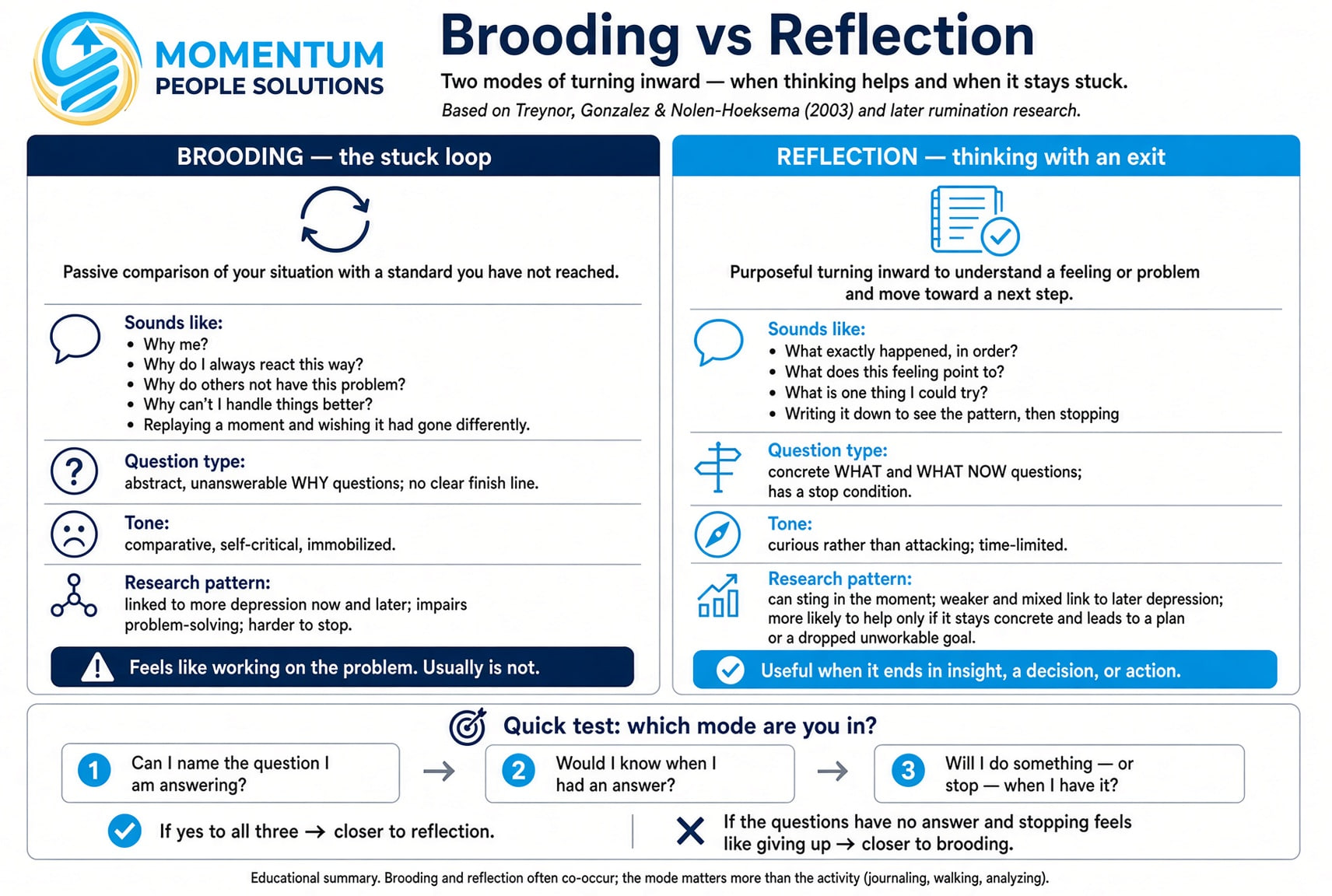
Brooding versus Reflection:
Treynor, Gonzalez, and Nolen-Hoeksema (2003) split the Ruminative Responses Scale into two factors: brooding and reflection. They defined reflection as:
“Purposeful turning inward to engage in cognitive problem-solving to alleviate one’s depressive symptoms.”
Reflection actions: going somewhere alone to think about why you feel this way, writing thoughts down and analyzing them, and analyzing recent events or your personality to understand the mood. Brooding, by contrast, is a passive comparison of your situation with an unachieved standard (“Why can’t I handle things better?” “Why do I have problems other people don’t have?”).
Reflection tends to be more helpful when it has these features:
- A stop condition: you are trying to understand this episode or decide one next step, then you leave it.
- Concrete questions (What happened, in order? What is one thing I can do Thursday?”) rather than abstract ones (“What does this mean about who I am?”).
- Curiosity rather than self-attack.
- Some psychological distance (for example, thinking about the event as if advising a friend, or from a later vantage point). Self-distancing research finds that this kind of reflection is more likely to produce insight without the mood spike of immersed replay.
- It leads to a plan or to dropping an unattainable goal, which is what self-regulation theories say makes self-focus useful rather than stuck.
Nolen-Hoeksema’s later review put it this way: pondering may be distressing in the short run but adaptive in the long run if it leads to effective problem-solving.
Caution: There is overlap between brooding and reflection. Check the story you are telling yourself to neatly fit in the definition of reflection, it might disguise brooding.
Reflection is not automatically a good use of energy. It is less reliably toxic than brooding, and it can be constructive, but it often starts as the same inward turn and only becomes useful if it stays concrete, time-limited, and tied to action or a changed appraisal.
More like reflection: you can say what question you are answering, what would count as an answer, and what you will do when you have it.
More like brooding: the questions are unanswerable (“Why me?”), the tone is comparative and self-critical, and stopping feels like abandoning the problem rather than finishing it.
With this understanding, I challenge myself to discover:
Am I telling myself an identity story?
Is there a learning or planning opportunity?
and
What can I do about my past now?