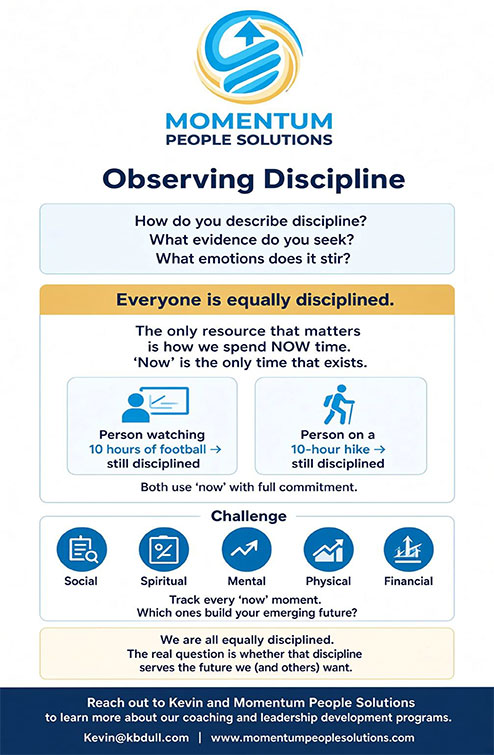
How do you describe discipline?
What external, observable evidence do you look for when assessing your own level of discipline—or someone else’s? Are there physical markers? What emotions arise when you witness it in action? Do you feel impressed, or does it leave you feeling inadequate? Do you immediately judge yourself against that standard?
What is your definition of discipline? Which adjectives come to mind when you picture someone highly disciplined? Do you measure it against a loved one, a mentor, a famous figure, an industry leader, or even a social media influencer?
Most of us treat discipline as a collection of positive traits. Most of us also believe it is unevenly distributed: some people clearly have it, while others clearly do not.
What if that assumption is wrong?
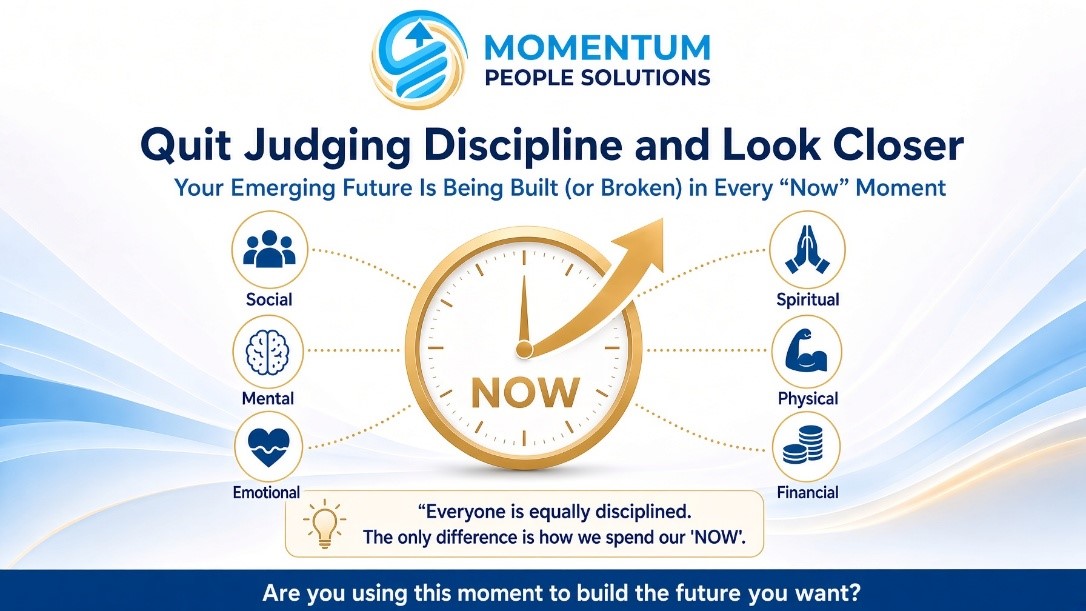
Everyone is equally disciplined. Everyone has equal access to the same fundamental resource for practicing discipline.
That resource is how we spend “now” time. (Ekhardt Tolle).
“Now” is the only time that actually exists. Right now, you are spending it reading these words. Elsewhere, people are caring for loved ones, training their bodies, answering emails, watching a game, scrolling social media, eating something indulgent, fantasizing about a better future, or ruminating on the past.
The person who spends ten hours watching football over the weekend is disciplined in the use of their “now.” So is the person who spends those same ten hours on a long hike. Both are fully committed to how they allocate the present moment.
Even the person lost in imaginary time—replaying old wounds or spinning future scenarios—is disciplined in the sense that they are consistently directing their attention. The person who remains anchored in the living present is also disciplined, especially when that presence is deliberately aimed at the actions that shape an emerging future.
Here is the practical challenge: How much of your “now” are you inhabiting, and is it positively reshaping the key segments of your life?
Pause and review the moments of a typical day. Sort them into these categories: Social, Spiritual, Mental, Physical, Financial. Which of those “now” moments actively build the future you want? Which one merely consumes time without adding to it—or actively diminishes it?
Then look outward. Notice how the people around you are spending their “now.”
The reflection is simple and equalizing: we are all equally disciplined. The only real question is whether that discipline is serving the emerging future we (and those we care about) actually want.
All of us enjoy the same opportunity. The difference lies solely in where we place our attention at this moment.
Citation: Concepts of psychological time versus the living present draw from the work of Eckhart Tolle, particularly as explored in The Power of Now, A Spiritual Guide to Enlightenment.